
RTK GPS for Excavators: When Precision Reduces Rework and Project Cost
Does RTK GPS Guidance Actually Pay Off on Excavator Projects? Yes, when grade accuracy, dredging depth, rework, survey time, or underwater...

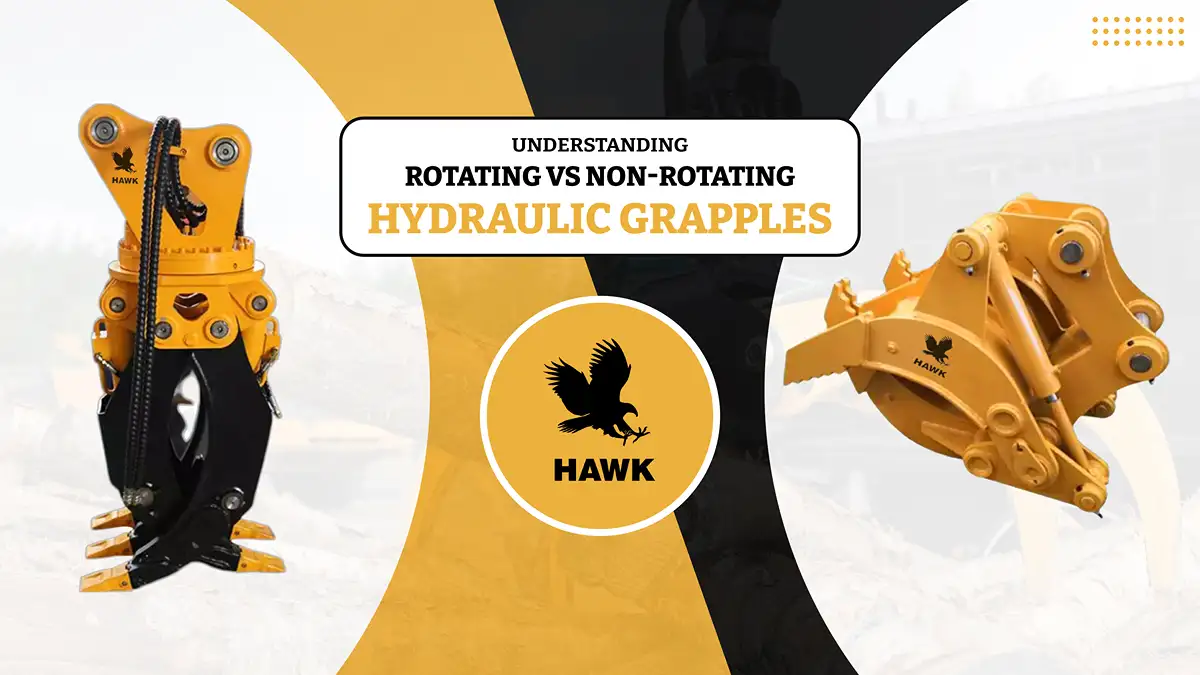
Hydraulic grapples change how you handle material on the jobsite. When you sort demolition waste, load scrap, clear land, or move logs, a grapple lets you work faster and with far more control than a standard bucket. You grip what you need, place it where it belongs, and move on without extra handling or manual cleanup.
But one decision shapes how effective that grapple will be. Do you need rotation at the grapple itself, or will a fixed setup get the job done? That choice affects productivity, machine movement, operator fatigue, and overall cost.
This guide breaks down hydraulic grapples in plain terms. You will see how rotating grapples and non-rotating grapples actually work in real conditions, where each option fits best, and what tradeoffs matter in day-to-day use. The focus stays practical and jobsite-driven, so you can choose the right setup without overspending, overcomplicating your machine, or ending up with an attachment that does more or less than you need.

A hydraulic grapple is a purpose-built attachment that uses your machine’s auxiliary hydraulics to power one or more jaws. Hydraulic cylinders open and close those jaws with controlled force, allowing you to grip material securely rather than scoop it. This changes how loads are handled at a mechanical level. Instead of relying on gravity and bucket shape, the grapple applies clamping force directly to the material.
That clamping action gives you far greater control over irregular, bulky, or mixed materials. Scrap metal, broken concrete, logs, brush, and demolition debris rarely sit cleanly in a bucket. A grapple conforms to the load, stabilizes it during lifting, and reduces shifting while swinging or placing.
Hydraulic grapples outperform buckets when material shape, orientation, and placement accuracy matter. They allow selective picking instead of mass loading, which is critical in workflows where materials must be sorted, staged, or positioned precisely rather than dumped.
You will typically see hydraulic grapples used in:
Compared to buckets, hydraulic grapples reduce the need to reposition the machine to stabilize loads. They shorten cycle times by allowing faster grab, lift, and place movements. They improve material separation by letting operators sort directly instead of piling everything together for later handling. Over a full shift, this means higher throughput, cleaner work areas, and less unnecessary machine movement.

A non-rotating grapple mounts directly to your coupler or stick and stays locked in place. The grapple does not rotate around its vertical axis. If you need to change the position of the material, you can do so by moving the machine itself or using the boom, stick, and curl functions. That approach is straightforward and familiar for most operators.
This fixed head design keeps things simple. With fewer moving parts, there are fewer hoses, seals, and bearings to worry about. That usually means lower upfront cost, less maintenance, and fewer things that can fail over time. For many crews, that simplicity is a major advantage.
Non-rotating grapples work best when the job follows a basic grab, lift, and place pattern. They are well-suited for tasks where speed and strength matter more than fine positioning.
Common use cases include:
If your work mostly involves grabbing material and dropping it into a truck, dumpster, or pile, a fixed head grapple often gets the job done with less cost and less complexity. For many operations, it is a dependable tool that fits the way the work actually happens on site.
A rotating grapple includes a hydraulic rotator mounted between the grapple body and the machine. This allows the attachment to rotate a full 360 degrees without moving the carrier. Instead of repositioning the excavator or loader, you rotate the grapple itself to line up the material.
A good way to think about it is wrist control. You adjust the load directly rather than adjusting the whole machine. That extra control becomes noticeable very quickly, especially in confined or busy job sites.
Rotating grapples cut down on wasted motion. Instead of swinging the house, tracking forward and back, or resetting your approach, you rotate the load into position and keep working. That saves time on every cycle and keeps the operation smoother.
You will notice the biggest gains when
Fewer machine movements lead to faster cycle times, less wear on the undercarriage, and better control when handling awkward or uneven loads. Over the course of a day, that efficiency adds up in a very real way.

Feature | Rotating Grapples | Non-Rotating Grapples |
Load positioning | High precision with 360-degree rotation | Limited to machine movement |
Sorting efficiency | Faster and cleaner | Slower with more repositioning |
Weight | Heavier due to the rotator | Lighter for a similar jaw size |
Hydraulic complexity | Higher | Lower |
Purchase cost | Higher | Lower |
Best for | Demolition, scrap, forestry | Brush, loading, simple handling |
This comparison highlights the tradeoff. Rotating grapples cost more and weigh more, but they often deliver higher output per hour in sorting and precision work.
Choose rotating grapples if you regularly sort, align, or place material, or if your site limits machine movement.
Choose non-rotating grapples if most lifts are simple and orientation rarely matters.
Different jobs reward different designs.
Match the grapple to the work you do most, not the work you do once a year.

Rotating grapples include precision components. Bearings, motors, swivels, and extra plumbing all add cost. They also require additional auxiliary hydraulics in many cases.
Non-rotating grapples stay simple, which keeps purchase price and setup time lower.
Do not judge ROI by purchase price alone. Look at what happens over a week or a month.
Ask yourself
If rotation cuts cycle time and improves control, the higher upfront cost often pays back faster than expected.
Every hydraulic grapple, regardless of style, needs regular inspection. These attachments work in harsh conditions, and small issues add up quickly if they go unnoticed. Routine checks help you catch wear early and avoid breakdowns that pull machines out of service.
Pay close attention to the core wear areas:
Rotating grapples add capability but also introduce components that require closer monitoring. These parts work continuously and are more sensitive to contamination and misalignment.
Make time to inspect:
Good maintenance keeps minor leaks, looseness, or uneven wear from turning into expensive downtime. A few minutes of inspection during regular service checks go a long way toward keeping your grapple reliable and your machine productive.

Industry data from 2024 and 2025 shows a clear shift toward more precise and versatile attachments, especially in recycling, demolition, and urban construction. As job sites get tighter and material handling becomes more complex, contractors are leaning toward tools that give operators better control without slowing down production.
One of the biggest trends is the increased use of rotating grapples in demolition and scrap work. The ability to rotate material instead of repositioning the machine saves time and reduces unnecessary movement. At the same time, buyers are paying closer attention to durability. Demand is growing for grapples built with high-strength steels, reinforced pivots, and wear packages that hold up under constant abuse. Integration with quick couplers is also becoming standard, allowing crews to switch attachments more quickly and keep machines working rather than sitting idle.
There is also growing interest in multi-tool setups that let one machine handle more tasks. Contractors want fewer machines on site doing more work, which helps control costs and simplify logistics. Hydraulic grapples, especially rotating models, align well with that shift by offering flexibility without adding complexity to the fleet.
A demolition equipment manager quoted in industry guidance summed it up clearly.
“When you sort material all day, rotation stops being a luxury. It becomes the fastest way to reduce wasted motion and improve safety.”
Another attachment specialist noted.
“Fixed grapples still make sense when the job is simple. Problems start when buyers expect precision from a tool built for loading.”
These views reflect what many operators experience on site.
Use this list to avoid mismatches.
Clear specs lead to better quotes and fewer surprises after delivery.

Hydraulic grapples expand what your excavator or carrier can do on the job. They make material handling faster and more controlled across construction, forestry, demolition, scrap, and similar work. The choice between a rotating and non-rotating grapple depends on how you work. A fixed grapple is simple, strong, and cost-effective. It works well for heavy lifting and jobs where precision is not a priority. A rotating grapple gives you more control and flexibility, which matters when material needs to be positioned accurately or when you are working in tight spaces.
There is no single right answer for every operation. You need to consider your typical applications, job site conditions, machine capabilities, and budget. If you want help choosing the right grapple for your equipment and workload, visit hawkexcavator.com to talk with a team that understands real job site demands. In some cases, a rotating grapple pays for itself through faster cycles and greater versatility. In others, a reliable fixed grapple delivers better value with lower cost and simpler maintenance. The right choice is the one that improves efficiency and keeps your crew working safely.
Get in touch with us now!
Does RTK GPS Guidance Actually Pay Off on Excavator Projects? Yes, when grade accuracy, dredging depth, rework, survey time, or underwater...
What Is Excavator Dredging? Excavator dredging is the process of using a hydraulic excavator equipped with a pump attachment to remove and transport...
Excavator pump attachments turn standard excavators into dredging systems by using the machine’s hydraulic power to drive a submersible slurry pump....